
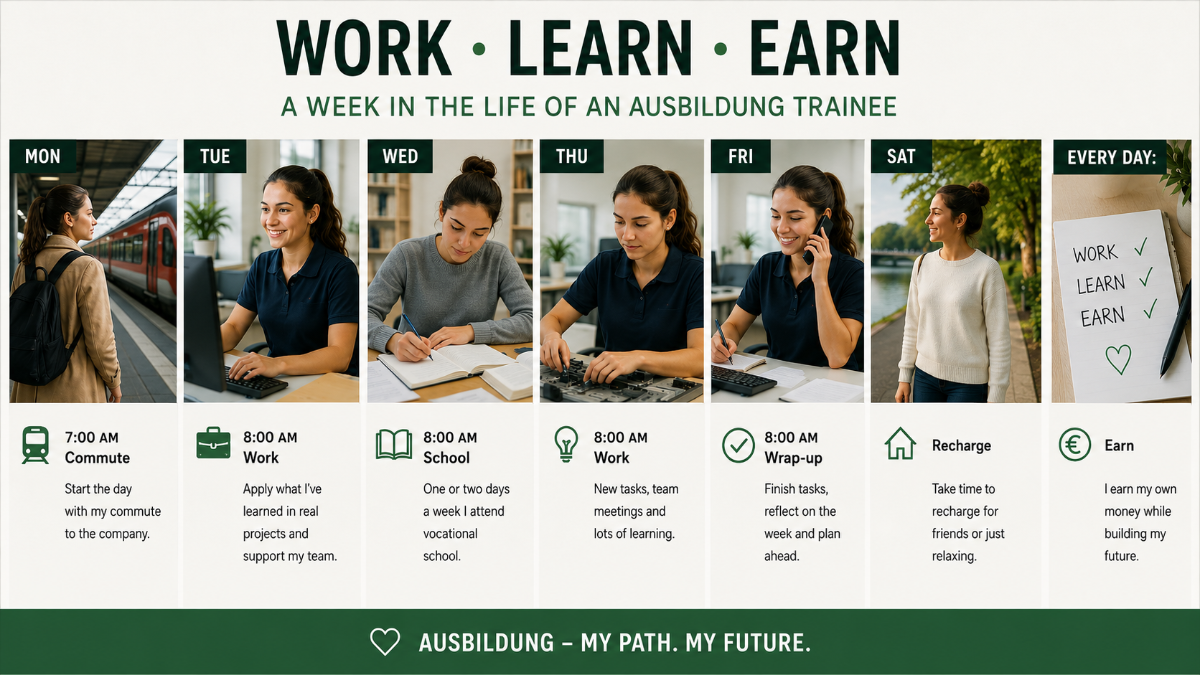
Most descriptions of Ausbildung stay abstract: "vocational training", "dual system", "work and study combined". Useful definitions, but they leave the most important question unanswered: what does a real week actually look like, day by day?
This article gives you a concrete picture of what trainees actually do, where they spend their time, how their week is structured and what they earn. It is based on the general structure of the German dual vocational training system as defined by the Berufsbildungsgesetz (BBiG), Germany's Vocational Training Act.
The Dual System: the Core Principle
The term "dual" refers to the two places of learning: the training company (Ausbildungsbetrieb) and the vocational school (Berufsschule). A trainee alternates between these two environments throughout the entire training period, which typically lasts between two and three and a half years depending on the sector.
This dual structure is a legal requirement. Every Ausbildung programme in Germany, regardless of sector, must include both the employer-based practical component and the state-funded school-based theoretical component. Neither can be skipped.
A Typical Ausbildung Week
The week starts at the training company. Trainees attend a brief team meeting, receive their tasks for the day and begin work. Typical activities depend on sector: a healthcare trainee might assist with patient care documentation; an IT trainee might shadow a systems integration project; a hospitality trainee might prepare for the morning service.
Continued practical work. Trainees are assigned to departments on a rotation schedule to build broad experience across the whole company. A mechatronics trainee might spend Tuesday in the electronics workshop; a logistics trainee might work in warehouse operations. The Ausbilder (in-company trainer) provides guidance and feedback.
One or two days per week are spent at the vocational school (Berufsschule). Here, trainees receive the theoretical foundation for their profession: technical knowledge, business German, legal basics and sector-specific subjects. Classes are taught by qualified teachers (Berufsschullehrer) and assessed regularly. Attendance is legally mandatory.
Back at the company. Thursday is often used for tasks that require full concentration: equipment calibration, patient assessments, software testing or complex kitchen preparation depending on sector. Trainees typically get increasing responsibility as they progress through their second and third years.
End of the working week. Many companies use Friday mornings for team debriefs and trainees are often asked to reflect on the week in their Berichtsheft (training journal), a legally required document where trainees record what they have learned and done each week. The Berichtsheft is reviewed by the Ausbilder and contributes to the overall training assessment.
Standard Ausbildung in most sectors is Monday to Friday. Weekends are free. Exceptions apply in sectors with weekend operations such as hospitality, nursing and elderly care, where shift rotas include weekends by agreement. These are compensated with equivalent weekday rest time as required by German labour law.
School Schedule Variations
The Berufsschule component varies slightly depending on the federal state (Bundesland) and the sector:
- Block model (Blockunterricht): several weeks of school attendance, then several weeks exclusively at the company. Common in some technical and healthcare programmes.
- Part-week model (Teilzeitunterricht): one to two fixed school days per week throughout the year. More common in IT, business and logistics programmes.
Your specific schedule is confirmed by your training company when you receive your contract. Both models cover the same curriculum content; only the timing differs.
Pay During Training
This is the aspect that surprises most Indian candidates: you receive a monthly training stipend from your first week.
| Training year | Typical monthly gross (EUR) | Approximate INR equivalent |
|---|---|---|
| Year 1 | € 900 to €1,000 | approx. ₹ 90,000 to ₹1,00,000 |
| Year 2 | €1,000 to €1,100 | approx. ₹1,00,000 to ₹1,10,000 |
| Year 3 / Final year | €1,100 to €1,200 | approx. ₹1,10,000 to ₹1,20,000 |
These are gross (before tax) figures. Actual net pay after income tax (Lohnsteuer) and social contributions (health insurance, pension, unemployment insurance) is approximately 70 to 75 percent of the gross amount, depending on the tax class assigned. The contributions cover full health insurance and pension entitlement from day one.
After completing the Ausbildung and passing the final examination (Abschlussprüfung), trainees who are employed in a skilled position typically earn €2,500 to €3,000 per month depending on sector and region.
What the Final Examination Looks Like
Every Ausbildung concludes with a state examination administered by the relevant Chamber (IHK for commercial and technical sectors; HWK for trades; LZK for healthcare, etc.). The examination tests both theoretical knowledge and practical skills. A trainee who passes receives a nationally recognised, legally protected professional title such as Mechatroniker/in, Pflegefachmann/Pflegefachfrau or Fachinformatiker/in.
This certificate has no expiry date and is valid throughout the entire European Union under the EU directive on recognition of professional qualifications.
What This Means in Practice
For an Indian candidate who has completed Ausbildung, the outcome is: a permanent professional qualification recognised across the EU, a full employment history with German social security contributions, a residence permit that is eligible for extension toward permanent residency (Niederlassungserlaubnis) after five years, and a career foundation that most university graduates take three to four additional years to build.
The investment is genuine effort for two to three years: showing up, applying yourself, improving your German and meeting the standards your employer and school expect of you. There are no shortcuts, but there is a clear and well-signposted path.
Start preparing for your Ausbildung today
Book a free counselling session and we will map your realistic pathway from where you are now.