
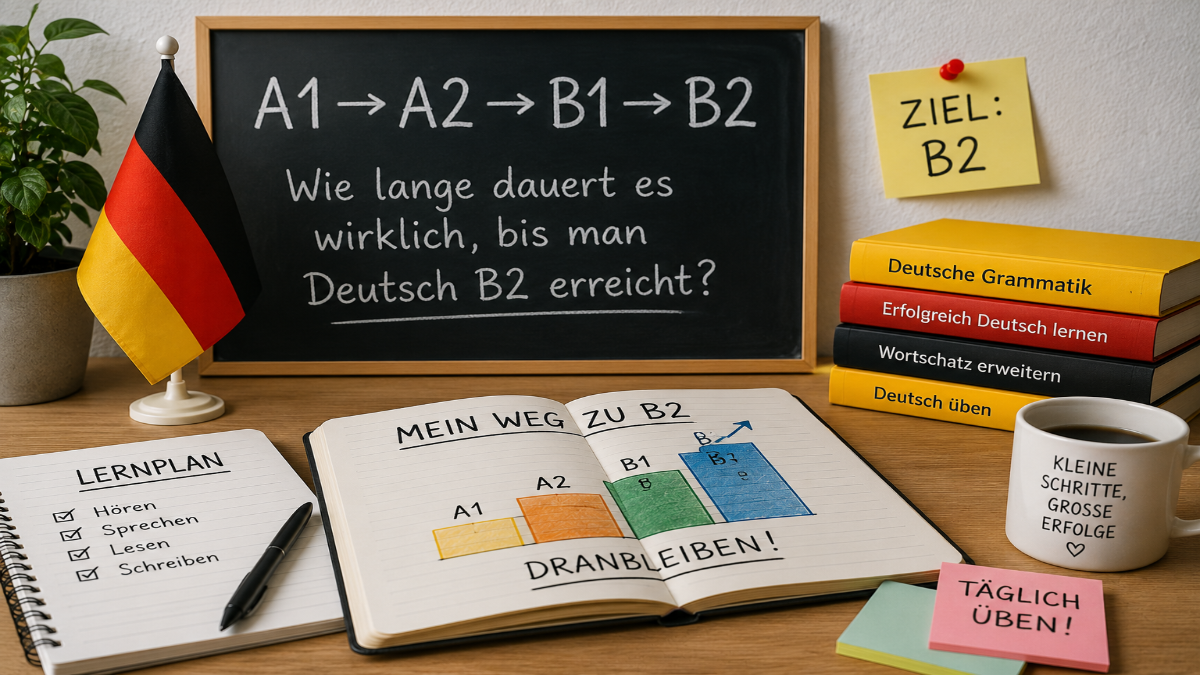
B2 is the level that unlocks Germany. For Ausbildung, most employers require it. For direct nursing careers, the recognition process requires it. For Au-Pair candidates, it significantly improves placement options. Without B2, no amount of preparation in other areas will get you there. So: how long does it actually take?
The short answer people want to hear: "six months." The honest answer: 10–14 months for a committed, full-time student. Longer if you are not consistent. Here is what the journey actually looks like.
Why B2 Takes As Long As It Does
German is not a language you absorb passively. Its grammar — cases (Nominativ, Akkusativ, Dativ, Genitiv), verb conjugations, word order rules, compound nouns — requires systematic learning and regular practice. Each level builds on the last. Skipping ahead doesn't work; gaps at A2 will haunt you at B1.
The Common European Framework (CEFR) estimates roughly 200 guided learning hours per level (A1→A2, A2→B1, B1→B2). That is 600+ hours from zero to B2. In a structured, intensive programme — like ours at Word Wings Academy (Mon–Fri classes + Saturday speaking practice) — that translates to approximately 10–14 months of real effort.
A Realistic Level-by-Level Breakdown
A1 — Foundation
Months 0–3You learn to introduce yourself, count, name everyday objects, understand simple spoken German and write short sentences. Grammar: present tense, basic nouns, numbers, greetings.
Milestone: Goethe A1 certificate. Coursebook: Netzwerk Neu A1.
A2 — Elementary
Months 3–6You handle routine conversations — shopping, directions, describing your daily life and simple work situations. Grammar: past tenses (Perfekt), modal verbs, Akkusativ and Dativ cases.
Milestone: Goethe A2 certificate. Coursebook: Netzwerk Neu A2.
B1 — Independent
Months 6–10You describe goals and experiences, express opinions, handle most everyday work situations and understand the main points of clear speech on familiar topics. Grammar: Genitivfall, Konjunktiv II (wishes), relative clauses, indirect speech.
Milestone: Goethe B1 certificate. Coursebook: Netzwerk Neu B1.
B2 — Work-ready
Months 10–14You understand the main ideas of complex texts, express yourself fluently and produce clear, detailed text on a wide range of subjects. This is the level German employers and the nursing recognition process require.
Milestone: Goethe B2 certificate. Coursebook: Kontext DaF B2.
What Makes the Difference
Two students in the same batch can produce very different results at the 12-month mark. One reaches B2 comfortably; the other is still consolidating B1. The difference is almost never intelligence — it is consistency of daily practice.
- Attend every class. One week's absence at B1 level breaks the grammar thread. It is not easy to catch up. At Word Wings Academy, max 20 students per batch means your absence is noticed and flagged early.
- Practice speaking outside class. Saturday speaking sessions are mandatory for a reason — reading and writing alone will not build the fluency employers need. Use German every day: WhatsApp messages, YouTube, German songs.
- Take the mock exams seriously. Weekly tests and mock exams are not bureaucracy. They identify exactly which skills are weak before the official Goethe exam.
- Don't skip levels. Students who try to jump from A2 directly to B2 preparation almost always fail the Goethe B2 — the grammar gaps are too large.
Common Mistakes That Add Months
- Starting "after summer" / "next month". Every delayed month is a delayed departure. The Goethe exam has fixed dates. Missing a slot can add 3–4 months.
- Joining a weekend-only class. 2 hours on a Sunday is not enough to progress through 4 levels in a realistic timeline. Intensive, daily training is the difference between 14 months and 3 years.
- Treating German as a checkbox. Employers test language during the interview — in German. A certificate alone is not enough if you cannot hold a conversation.
- Stopping at B1. B1 is a milestone, not the destination. For Ausbildung and nursing, B2 is non-negotiable. B1 is not "almost there" — it is halfway.
Honest timeline summary
Full-time, structured programme (Mon–Fri + Saturday): 10–14 months A1→B2.
Part-time or weekend-only: 24–36 months, with higher drop-out risk.
Zero-to-B2 "in 6 months": not realistic for most students — often leads to poor exam results.
The Honest Bottom Line
B2 in 10–14 months is achievable — but only with the right structure, the right batch size and genuine daily effort. It is not a course you can half-attend. It is 10–14 months of discipline that unlocks a career that most people around you will never have access to.
When parents ask why the process takes 18–24 months from enrolment to Germany, the answer is: 10–14 months of language preparation, plus 4–8 months of documentation, recognition and employer matching. There are no shortcuts in either part.
Ready to start your A1→B2 journey?
Join a demo class at Word Wings Academy — sit in on a real lesson and meet the teacher before you commit.